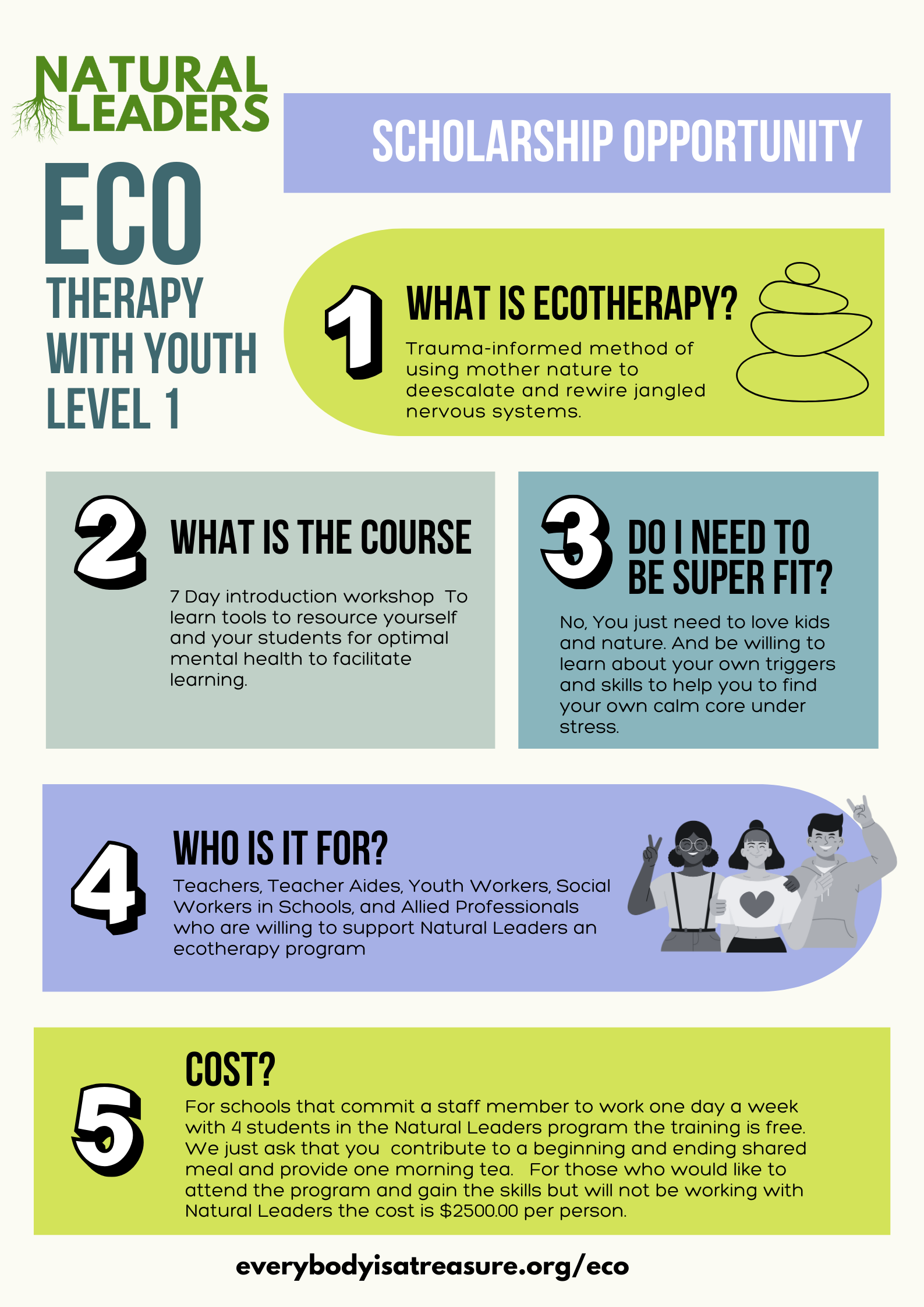
What is Creative Somatic Ecotherapy?
What is Creative Somatic Ecotherapy in schools?
7 day training to decrease risk of teacher burnout and increase the tool kit for working with education challenges. The goal with our Creative Somatic Ecotherapy program is to provide people who work with youth tools to reconnect themselves to the calming natural battery of Mother Nature. It helps you identify blocks to your core of calm, compassion, courage, and curiosity that we all have but that life and challenges may have blocked to varying degrees.
What are the trickiest things for teachers? - Most teachers report the risk of burnout and student behaviour problems as their biggest challenges. Which can lead to:
- Frustration
- Feeling like you don't know what to do next to help the student.
- It can feel like they are exposing your weaknesses as an educator
- You can end up in battles with them and stop seeing the good inside them.
Our students who come from histories of trauma can often trigger our own unexamined "stuff". Those who learn differently and whom we have had difficulty reaching in the four walls of a school may need an alternative way of supporting their needs.
Ecotherapy is not a new concept. It has been an inherent aspect of our existence on Earth for as long as we have been here. Body or somatic-based practices are ancient ways of finding our calm, as are the positive use of creativity. In this program, the three gems are woven naturally to form one modality.
It's only a recent development in human evolution where being in nature is something we go and "do." Before this, our interdependence with nature was an obvious necessity. Consequently, as research shows, the absence or forgetting of this necessity results in many harmful and discouraging effects, both personally and collectively.
Ecotherapy, then, involves the intentional re-connection with the natural world as a profound gateway to our healing and renewal.
Who is the training for?
On the last day of our training participants are asked who they would recommend attend the training in the future and these have been their answers:
- Principals
- Board members
- Teacher Aides
- Youth workers
- Teachers in charge of EOTC
- Truancy officers
- Iwi Social Service Kaimahi
- Families/parents that home school their children.
- Social Workers in Schools (SWIS)
- Learning Support Coordinators
- Public servants who are stressed and need a reset
- All leaders
- All mothers
- All fathers
- Young woman even just contemplating motherhood, and pregnant women.
- Youth - children encouraging this in imagination and play.
- Social workers
- Women refuge workers
- All outdoor educators
- Counsellors
- Healers of all types
- Policemen
- Dentists
- Doctors
- Scientists
- Politicians
- "Kaiako, support staff, whānau who want to feel a deep sense of personal connection to the whenua and life force of oneself. To then be able to model Eco-regulation and share their wisdom with tamariki/rangatahi to equip them to be life-long learners in the bustling, diverse 21st century."
- "Any aspiring leader on any level, like a mum, a teacher or a rugby coach"
- "To be honest, all souls - especially those who struggle to calm their nervous system, mental health, youth, and addictions (this is a big space!)
- All wāhine circles, and there's a massive need for men groups leaders so we can bring tāne on the journey with us."
-
"Everyone!! It could be someone needing to fight their demons, someone needing a break from the chaos of everyday life. Every single person would gain at least one thing from this experience.
When asked why these people should attend here were the answers:
- Self-care, therapeutic process
- Increased self-awareness
- Relationship with nature strengthened
- Extend my therapeutic vocabulary and experience
- Supervision from Ranginui and Papatūānuku
- WOF Eco test Recalibrate with nature - Feel more connected with nature and self.
The Structure of this Training
This is a four-module 7 day training and includes an overnight wilderness vigil held at a later date.
The purpose of the training is to support participants in
- developing their own intimate relationship with nature,
- developing a solid structure for facilitating an Ecotherapy session with youth,
- incorporating a number of different therapeutic modalities well suited for this work (see above)
- determining where their own particular level of comfort is in this way of working.
Each of the four modules will revolve around the theme of one of the four cardinal directions (North, South, East and West) and their associated stages of human development and transformation (drawn particularly from the work of Meredith Little and Steve Foster and the School of Lost Borders, and from the work of David Talamo and Wilderness Reflections). As part of each module, participants will explore each of these developmental stages in relation to their own personal life journeys, in relation to the various cycles found in nature, and with regard to facilitating the healing and transformation of their clients.
Course Framework: 4 Modules
Module 1: "Establishing Basecamp" - Resourcing
Theme: Gathering tools for connection with the calm, compassionate, and courageous core of ourselves and our students through the process of connecting with deeper layers of Mother Nature.
Module 2: "The Foothills" - Accessing Theme: Identifying where to even start and then beginning the adventure.
Module 3: "The Wilderness" - Processing
Theme: Navigating the territory of unhealed wounds and unresolved trauma.
Module 4: "Back to Basecamp" - Integration
Theme: Weaving the rewards of this transformative journey into ordinary consciousness and our everyday life.
-----------
(Note: There is an invitation to participate in an overnight wilderness vigil. More information can be provided upon request)
Instructors
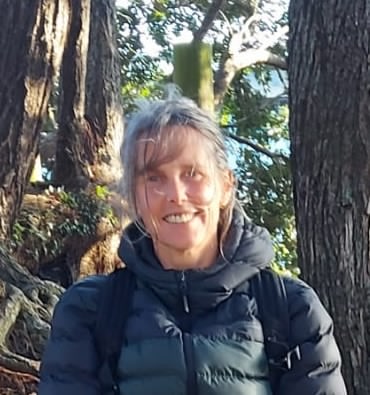
Toni McErlane, B.Sc.
Counsellor, Ecotherapist, Mediator, Nonviolent Communication facilitator & Nature Connection Guide
Toni is the director and primary counsellor for Restorative Relationships. She has developed a wide array of approaches to working in the field of restorative relationships. She obtained a Bachelors Degree in Counselling, The American certificate in horticulture therapy and has completed a 94hr Professional Ecotherapy Program with Dave Talamo from Wilderness Reflections in California.
She completed the North American yearlong Nonviolent Communication (NVC) Leadership Programme, and has trained extensively in conflict resolution, restorative circles, wilderness therapy, Hakomi for couples, mindfulness & somatic approaches to working with trauma. Toni is an AMINZ associate Family Dispute Resolution Provider (FDR) and in 2017 completed the year long Te reo Maori level Two through Te Wananga o Aotearoa.
Her approach towards supporting healthy relationships is from the humanistic and ecological perspective that all of our actions are attempts to meet needs and that we all have the intrinsic possibility to actualize our potential for wholeness. Our emotions are helpful guides that orientate us towards surviving and thriving, and by cultivating an "allowing" presence with our emotions, we can develop a comfortable, trusting relationship with them. Our relationship with nature is vital to developing a complete sense of self, place, belonging and self-growth.
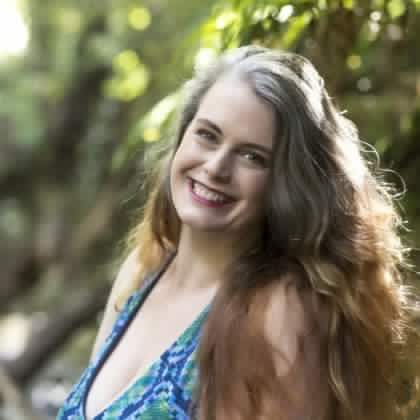
Mandi Lynn,
BSN, MNZIPP, PgD Social and Community Leadership
The founder and director of Every Body is a Treasure Trust.
Her focus is on identifying trauma blocks to the flow of creative energy in people she works with.
She is a Holistic Nurse, Somatic Therapist, Needs Based Coach, Master Photographer, Multi Award Winning Filmmaker, Body Positive Advocate, Organic Farmer and Prior US Naval Officer. She is co-founder of the Natural Leaders program.
Mandi will be teaching the Embodied Creativity framework, which is the framework that will be used in Natural Leaders. This diagnostic framework enables people to identify where in their system they are blocking their creative flow and provides tools to unblock and gain access to our best work.
Mandi has the lived experience of starting and running the Natural Leaders program with educators in the Upper Hutt region and provides the pragmatic grassroots support to develop this program in other regions.
She also is the mentor for Create Happy Media which grew out of her creative youth work programs and is now a national program run by youth for youth to amplify youth voice.
What is Natural Leaders
Natural Leaders is an ecotherapy bushcraft / bush arts program developed in Upper Hutt as a one-day school. It is a nature-based program designed to support the well-being and social skills of our students who struggle to learn in four walls. This can be due to trauma or neurodiversity or experiences of bullying. It is a way to teach pragmatic life skills, self leadership, bushcraft skills, and creativity skills to our youth who experience challenges fitting into mainstream education. In Upper Hutt is run in collaboration with Every Body is a Treasure Trust in collaboration with UHub, Piki Te Mauri Attendance Services, and UHAG (Upper Hutt Autism Group), Maidstone Intermediate, Heretaunga College, Fergusson Intermediate. and Te Kura o Hau Karetu.
Our hope is that we can take our knowledge from our program and share it with other regions.
About this training
This training draws from the work of many before us - those who have received ways of honoring, connecting to, and relating to the natural world from a long line of wisdom keepers.
Alongside this ancient wisdom, we bring the recent knowledge and expertise of the teachers who have dedicated much of their personal and professional lives to broadening the access to, and supporting the embodiment of, these teachings.
The primary professional modalities that inform this training are: Somatic Ecotherapy, Nonviolent Communication (NVC), Hakomi Mindful Somatic Psychotherapy, Internal Family Systems, Creative Arts Therapy, and Mindfulness.
The specific lineage-holders of knowledge that this training takes particular inspiration from are: Dave Talamo with Wilderness Reflections; Steve Foster and Meredith Little with The School of Lost Borders; Joanna Macy with The Work that Reconnects; Marshall Rosenberg and Nonviolent Communication, Jon Young with the Wilderness Awareness School; Bill Plotkin and the Animus Valley Institute; Ron Kurtz and Hakomi Mindful Somatic Psychotherapy, and S.N Goenka with the Vipassana Meditation Centre.
Natural Leaders Example programs
Natural Leaders is the program that is the pragmatic application of the Ecotherapy Program for schools. Our pilot was run with two separate cohorts. One that were our wildlings who wanted to learn bushcraft and the second were our students who had a creative flair. Many were neurodiverse and many had histories of trauma. These are some examples of activities we have done with our students in the Natural Leaders program. Please note that the student teacher ratio worked out to be much lower than we initially expected for the age of the students. For the pilot while getting to really know the students a 3:1 ratio is max for the level of behaviour challenges we were initially faced with in the pilot. Each week we are seeing the students settle into the program and we are able to increase that ratio. We have done this by splitting our initial groups in half so that the students attend every other week. Our recommendation is that for the first term you bring in a small group of students who are interested in Bushcraft or Natural Art and who have a strong natural leadership skill base to them with. Then you split them up and have them be the ones who set the tone for new groups that may have higher needs.